In historic Salt Lake City neighborhoods like The Avenues, Capitol Hill, and Yalecrest, decades-old Douglas fir and native pine framing often harbor anobiid powderpost beetles or old-house borers. Elevated baseline…
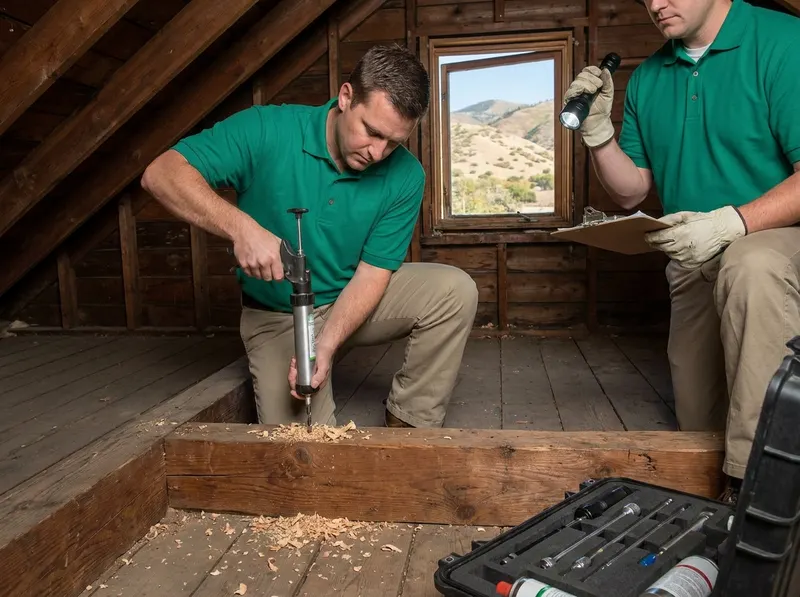
In historic Salt Lake City neighborhoods like The Avenues, Capitol Hill, and Yalecrest, decades-old Douglas fir and native pine framing often harbor anobiid powderpost beetles or old-house borers. Elevated baseline humidity in unencapsulated crawlspaces or stone foundations allows larvae to feed inside dimensional lumber for several years before adult beetles emerge through telltale round exit holes. Unlike surface insect issues, internal larval galleries weaken structural load capacities without altering the external timber profile until serious structural compromise occurs.
Standard surface fogging or perimeter barrier sprays fail against wood-destroying beetles because larvae feed deep inside structural sapwood. Effective remediation relies on direct structural intervention: applying high-concentration disodium octaborate tetrahydrate (DOT) solutions that penetrate through timber grain, or pressure-injecting galleries where timber density prevents uniform surface migration. This approach halts current larval development and creates a long-term chemical barrier that prevents future re-infestation when newly hatched larvae attempt to feed.
Property buyers and owners navigating real estate contingencies near Sugar House Park, Liberty Wells, or Federal Heights frequently encounter wood-destroying insect inspection reports demanding documented eradication. Remediation protocols provide verified structural defense by stabilizing timber moisture levels, applying certified structural borates, and documenting remediation metrics for mortgage lenders and municipal inspection authorities.
Every job gets a firm, written price after a free on-site visit.
Tell us about your wood-boring beetle timber remediation job in Salt Lake City and we'll send a clear, written quote — usually the same day.
 Velqora Termite Management